Building AI Teammates with Amazon Bedrock
Welcome to Building AI Teammates with Amazon Bedrock. In this guided, two-hour workshop, you will move TaskFlow from raw customer evidence to a supervised AI delivery pipeline using Claude Code through Amazon Bedrock.
You will create durable artifacts at every stage: structured evidence, prioritized requirements, a bounded specification, a reviewed design, executable tests, working code, and an optional Ralph pipeline. The workflow—not a chat transcript—preserves the state and the human approval gates.
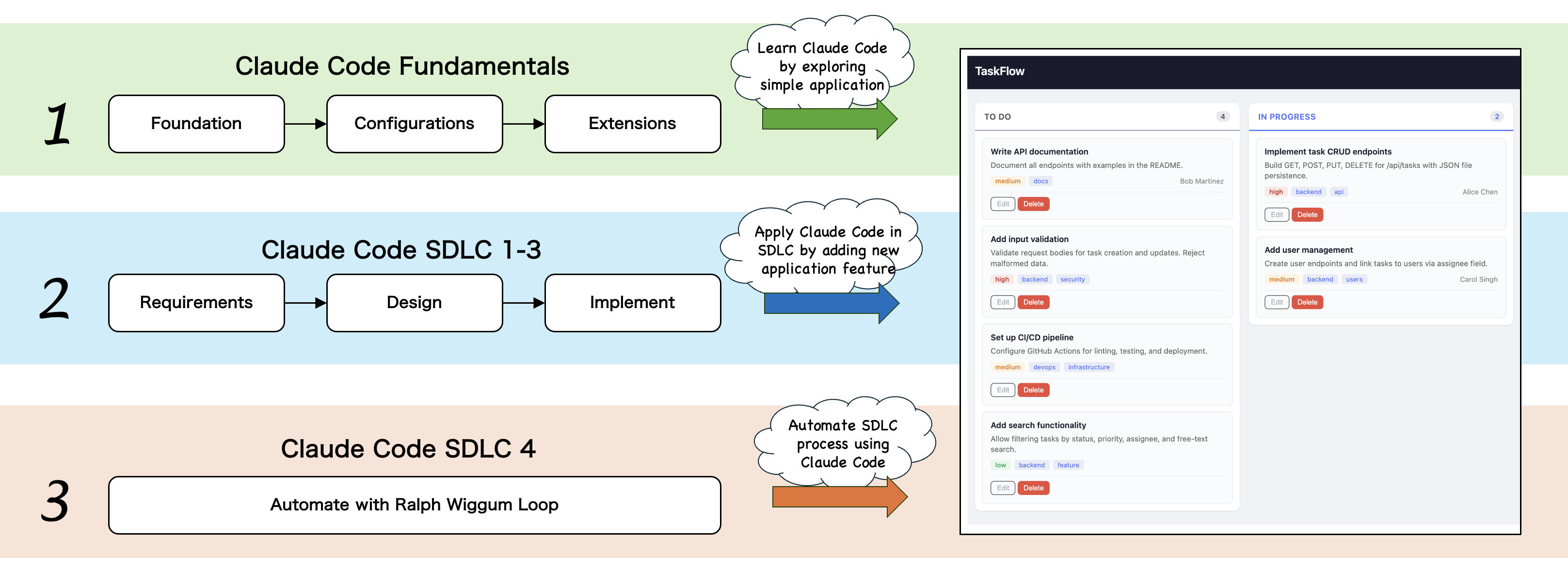
This workshop is designed for software developers, tech leads, and architects who want to integrate AI-assisted development into their workflow. It is hands-on and code-focused — you will be writing prompts, creating configuration files, and building real features throughout.
Participants should be comfortable with:
- Command-line basics — navigating directories, running commands in a terminal
- JavaScript/Node.js fundamentals — the sample project uses Express.js, though deep JS expertise is not required
- Git basics — clone, commit, branch (used for version control during exercises)
- REST API concepts — HTTP methods, status codes, JSON request/response (the sample project is a REST API)
No prior experience with Claude Code or AI-assisted development is needed — the workshop teaches everything from the ground up.
You need access to the workshop Code Editor environment — your facilitator will provide the URL. Everything else is pre-installed and ready.
This workshop uses Claude models hosted on Amazon Bedrock. Claude Code works seamlessly with Bedrock, so you get AI-assisted development within your existing AWS infrastructure, VPCs, and security boundaries.
When running this workshop at an AWS-hosted event, the environment is provided at no cost to participants. If you deploy the workshop infrastructure in your own AWS account, you will incur costs for the EC2 instance, CloudFront distribution, and Amazon Bedrock model usage. See Amazon Bedrock pricing and Amazon EC2 pricing for details. Remember to delete the CloudFormation stack when you are done to stop incurring charges.
Click Introduction to learn what this workshop covers, or jump straight to Getting Started if you are ready to begin.